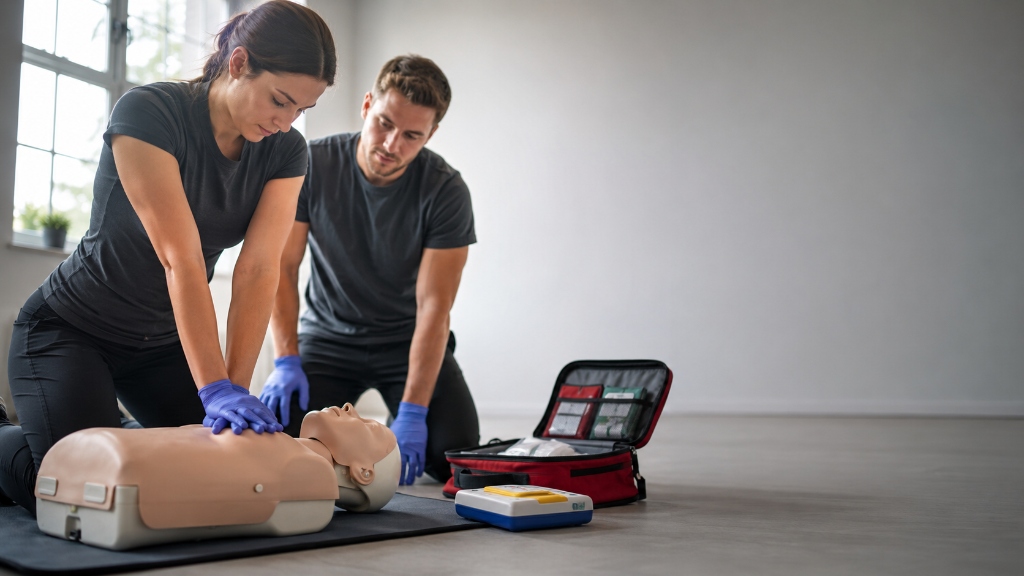
Emergency First Aid at Work training session
Bluewatch Training · RLSS UK · 1 Day

Emergency First Aid
at Work (EFAW).

One day. Level 3. Practical emergency first aid for the workplace. Emergency First Aid at Work gives nominated workplace first aiders the skills to respond to common workplace emergencies — CPR, AED use, choking, bleeding, shock, unresponsive casualties and incident assessment. Designed to support workplace first aid provision under HSE / HSENI requirements where identified by the employer’s first-aid needs assessment.

RLSS UK · Level 3
Ofqual Regulated
Supports HSE / HSENI Requirements
1 Day · Valid 3 Years
What is EFAW?

A recognised first aider qualification for many workplaces.

Emergency First Aid at Work (EFAW) is a one-day RLSS UK Level 3 qualification covering CPR, AED use and essential emergency first aid skills. It is designed for nominated first aiders in workplaces where the first-aid needs assessment identifies emergency first aid cover as appropriate, and is designed to support workplace first aid provision under HSE / HSENI requirements.

After completing the RLSS UK EFAW course, candidates receive an Ofqual-regulated Level 3 Emergency First Aid at Work qualification suitable for many workplace first aid arrangements.

EFAW is often suitable for lower-risk workplaces and organisations. For higher-risk environments, larger workforces or where a more comprehensive qualification is identified by the first-aid needs assessment, the three-day First Aid at Work (FAW) course is more likely to be appropriate.

RLSS UK’s Emergency First Aid at Work training is CIMSPA endorsed and regulated by Ofqual, Qualifications Wales and CCEA in Northern Ireland.

Course overview

Duration

1 day — normally 6 hours of course content, deliverable in one day or in smaller sessions where available in line with current RLSS UK requirements

Qualification

Level 3 Emergency First Aid at Work (RLSS UK)

Regulation

Ofqual regulated (also accredited by Qualifications Wales and CCEA in Northern Ireland). Designed to support HSE / HSENI workplace first aid requirements.

Validity

3 years. Renewal required for continued coverage.

Delivery

At your venue or an agreed Bluewatch Training venue.

Minimum age

16 years old at time of assessment.

Enquire about this course
What you learn

Course content

The EFAW course covers the essential first aid knowledge and practical skills needed to respond to an emergency in the workplace.

Roles & Responsibilities

Understanding the role of the first aider in the workplace — legal duties, the limits of first aid and when to call emergency services.

Assessing an Incident

Scene safety, primary survey, the DRABC/DR ABC approach to casualty assessment and establishing whether a casualty is conscious and breathing.

CPR & Basic Life Support

Adult CPR and the chain of survival — recognising cardiac arrest, initiating CPR, correct compression technique and the role of early defibrillation.

AED Use

Operating an Automated External Defibrillator — safe deployment, pad placement, minimising interruptions to CPR and post-shock recovery.

Choking

Recognising and treating choking in adults — back blows, abdominal thrusts and the progression to CPR if a casualty becomes unconscious.

Wounds, Bleeding & Shock

Managing minor and severe bleeding, wound dressing techniques and recognising and responding to circulatory shock following blood loss or trauma.

Unresponsive Casualty

Placing an unconscious breathing casualty into the recovery position and monitoring until emergency services arrive.

Minor Injuries

Treatment of minor wounds, burns and scalds, and first aid guidance for common workplace injuries — practical skills for everyday first aid situations.

Who it's for

Suitable for many lower-risk workplaces.

The Health and Safety (First-Aid) Regulations 1981 require employers to provide adequate and appropriate first-aid equipment, facilities and personnel. What is adequate and appropriate depends on the workplace, workforce and hazards present, so employers should carry out a first-aid needs assessment to identify the level of provision required.

For many lower-risk workplaces, EFAW may be an appropriate first aider qualification. It is often suitable for:

  • Offices, retail, hospitality and lower-risk workplaces
  • Nominated first aiders where the needs assessment identifies a requirement for emergency first aid cover
  • Small businesses, community groups and voluntary organisations
  • Sports clubs and leisure organisations
  • Staff wanting first aid confidence

Higher-risk workplaces, larger workforces, remote sites or settings where the needs assessment identifies a need for more comprehensive provision should consider First Aid at Work (FAW) instead. Employers remain responsible for determining the level of first aid provision required for their organisation.

EFAW vs FAW — which do you need?

EFAW — 1 Day

Often suitable for lower-risk workplaces where the first-aid needs assessment identifies a requirement for emergency first aid cover. Covers essential emergency response skills.

FAW — 3 Days

Often more suitable for higher-risk environments, larger workforces or settings where more comprehensive first aid provision is identified by the first-aid needs assessment.

Not sure which you need? Tell us about your organisation type, workforce and risk level and we can help identify whether EFAW or FAW is likely to be more suitable.

Ask us which course is right for your organisation

Important for employers

EFAW may be suitable for many lower-risk workplaces, but it should be chosen as part of your organisation’s first-aid needs assessment. Employers remain responsible for deciding what first aid equipment, facilities and personnel are adequate and appropriate for their workplace, workforce, location, working patterns and activities.

Bluewatch Training can discuss whether EFAW, FAW, Paediatric First Aid, Outdoor First Aid, AED or Anaphylaxis Management may be more suitable for your organisation, but this does not replace the employer’s own first-aid needs assessment. Learners must be physically able to take part in practical elements such as CPR, recovery position and casualty assessment, or should contact Bluewatch Training in advance to discuss any reasonable adjustments or support needs.

What happens on the day?

Practical, trainer-led and hands-on.

The EFAW course is practical and classroom-based. Learners should expect:

  • Trainer-led teaching and explanation of key first aid principles
  • Hands-on CPR and AED practice using training equipment
  • Casualty assessment and emergency response scenarios
  • Recovery position, choking response and wound management practice
  • Group discussion and question time
  • Assessment against required RLSS UK learning outcomes

Learners should wear comfortable clothing suitable for practical floor-based activity including CPR and recovery position practice. EFAW enquiries are welcome from employers, schools, sports clubs, leisure venues, community groups and small businesses across East Yorkshire and the Yorkshire coast, including Bridlington, Filey, Scarborough and Whitby.

EFAW may be a good fit for

  • Lower-risk workplaces identified by the needs assessment
  • Small teams or organisations
  • Offices, shops and hospitality settings
  • Community, voluntary and sports club settings
  • Staff nominated to provide emergency first aid cover

EFAW may not be sufficient where

  • The workplace has higher-risk activities or hazards
  • There is a larger workforce or remote working
  • The needs assessment identifies a need for full FAW
  • Vulnerable service users, complex activities or a high-risk environment
View First Aid at Work (FAW) →

Book EFAW for your team

Tell us your organisation type, number of learners, preferred location, timescale and whether you have already carried out a first-aid needs assessment. We can help identify whether EFAW is the right course, or whether FAW, Paediatric First Aid, Outdoor First Aid, AED or Anaphylaxis Management may be more suitable.