Half a day. A nationally regulated RLSS UK Level 2 Award. The AED Programme gives workplaces, sports clubs, leisure venues and community groups the confidence to recognise cardiac arrest, start CPR, use an AED safely and support the casualty until emergency services arrive. Delivered by Bluewatch Training across Yorkshire and the East Riding.
Survival from out-of-hospital cardiac arrest is strongly linked to how quickly a defibrillator is used and CPR started. The RLSS UK Automated External Defibrillator (AED) programme teaches participants how to give effective CPR and operate an AED — building the confidence to act in the critical minutes before emergency services arrive.
The course takes approximately 4 hours and leads to a nationally regulated RLSS UK Level 2 Award in Automated External Defibrillator, regulated by Ofqual, Qualifications Wales and CCEA in Northern Ireland. The certificate is valid for 2 years from assessment. It is available as a standalone qualification or as part of a broader first aid programme for your organisation.
If your workplace, sports club or community space has an AED on-site — or is planning to — this course gives staff the skills and confidence to use it.
Duration
Approximately 4 hours
Qualification
RLSS UK Level 2 Award in Automated External Defibrillator
Regulation
Regulated by Ofqual, Qualifications Wales and CCEA in Northern Ireland
Validity
2 years from assessment
Endorsement
CIMSPA CPD points may apply where confirmed current and course-specific
Delivery
At your venue or an agreed Bluewatch Training venue
Minimum age
16 years old at the time of taking the AED Programme
Group size
Suitable for small teams or large groups — get in touch to discuss.
Practical, hands-on training that equips participants with real confidence to respond to a cardiac arrest — not just theoretical awareness.
The signs of cardiac arrest, including agonal breathing, unconsciousness and absence of normal breathing — and how to respond immediately.
Understanding the chain of survival — early recognition, early CPR, early defibrillation and early advanced care — and why each link matters.
Correct adult CPR — hand position, compression depth and rate, rescue breaths and how to sustain effective CPR until the AED arrives or help takes over.
Switching on, pad placement, the voice prompts and decision process — including safe delivery of a shock and resuming CPR immediately afterwards.
Coordinating CPR and AED use as part of a team response — how to organise bystanders, minimise interruptions and hand over to paramedics.
Basic awareness of AED readiness checks, pads, batteries, cabinet access and reporting issues — and how to ensure the device remains ready for use when it is needed.
Organisations should know where the AED is kept, who checks it regularly, whether pads and batteries are in date, how staff access it quickly in an emergency, and whether it is registered on The Circuit — the national defibrillator network — so ambulance services can locate the nearest registered defibrillator when someone calls 999.
This course covers AED readiness checks as part of the programme. Many first aid courses include basic AED use, but the standalone RLSS UK AED Programme provides a separate certificated AED qualification and more focused CPR/AED practice. It can also be added to a wider first aid training programme such as EFAW or FAW.
Discuss AED training for your venueAEDs give clear voice prompts and will only deliver a shock when needed. This course helps staff, volunteers and community members feel more confident recognising cardiac arrest, starting CPR, using the AED and working as a team while emergency services are on the way.
AED training can significantly improve a team’s readiness to respond in the critical first minutes of a suspected cardiac arrest — the period when early action matters most.
Book AED training for your teamIf your organisation has an AED, is installing one, or relies on a nearby public access defibrillator, this course can help staff and volunteers understand what to do in the first critical minutes of a suspected cardiac arrest.
If your premises has a defibrillator installed — or you’re planning to — ensure your team knows how to use it. This session is ideal for staff training alongside your existing first aiders, and can be added to EFAW or FAW training.
Cardiac events during exercise are rare — but when they happen, early CPR and defibrillation can make a critical difference. Ideal for coaches, club volunteers, gym staff, leisure centre teams and committee members.
Parish councils, community centres, schools, places of worship, village halls, holiday parks, event teams and volunteer groups — AED training is a practical, impactful way to build community first aid capability.
Successful candidates receive the RLSS UK Level 2 Award in Automated External Defibrillator. The certificate is valid for 2 years from assessment. To renew, candidates must requalify by being assessed against the required learning outcomes and assessment criteria — normally by completing the 4-hour AED Programme again.
The course includes:
Learners should wear comfortable clothing suitable for floor-based CPR and AED practice. For organisations booking on-site delivery, Bluewatch Training can deliver the course at your workplace, club, venue or community setting, subject to suitable space, learner numbers, practical assessment requirements, access, course requirements and instructor availability. Learners should contact Bluewatch Training in advance if they have accessibility needs, medical considerations or concerns about taking part in practical CPR and AED assessment. AED training enquiries are welcome from workplaces, sports clubs, gyms, leisure venues, schools, parish councils, community centres, holiday parks and event teams across East Yorkshire and the Yorkshire coast, including Bridlington, Filey, Scarborough and Whitby.
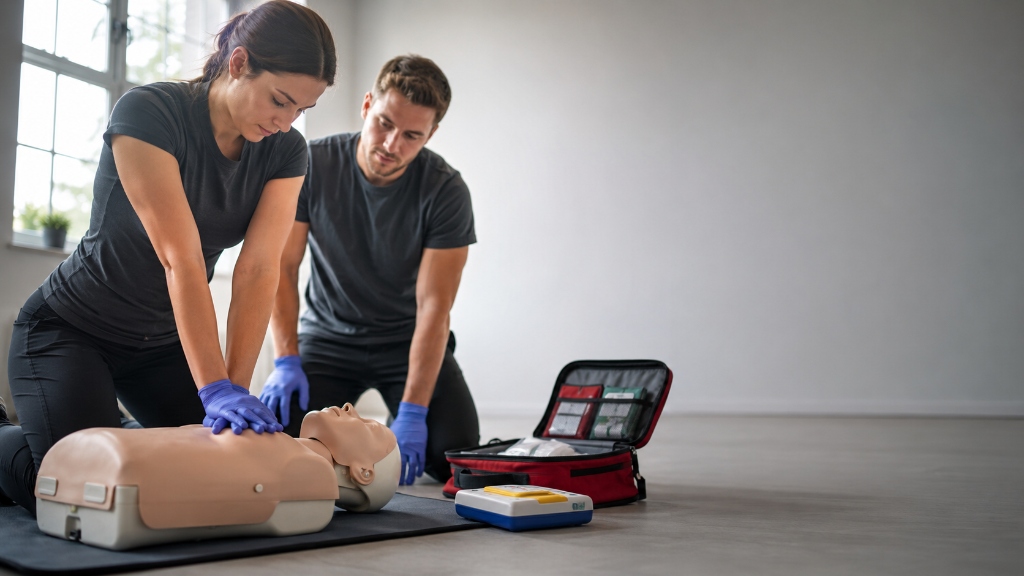
This course may be a good fit for
AED training supports staff and volunteer confidence, but it does not replace wider emergency procedures, first aid provision, AED maintenance checks, incident reporting, risk assessments, safeguarding arrangements or calling 999 in an emergency.
Enquire about AED training →→ Where it is kept
Is it accessible quickly? Do all relevant staff and volunteers know where it is?
→ Who checks it
Is there a named person responsible for regular readiness checks, pads and battery status?
→ Pads and battery dates
Expired pads or flat batteries mean the AED cannot deliver a shock when needed. Check expiry dates regularly.
→ Cabinet access
Is the cabinet unlocked or accessible to staff in an emergency, 24/7 if publicly accessible?
→ Registered on The Circuit
Registering on The Circuit — the national defibrillator network — means ambulance services can direct bystanders to your AED when someone calls 999.
→ Fault reporting
Is there a process for reporting faults, missing equipment or a device that has been used? Does your emergency procedure reflect where the AED is?
Half-day Level 2 awareness course — recognising and responding to anaphylaxis, EpiPen use and allergy emergency management.
View course → 🩺One-day Level 3 workplace first aid qualification covering emergency first aid skills. Often combined with AED training for a complete workplace first aid programme. Course selected based on workplace first-aid needs assessment.
View EFAW → 🎓View our full range of RLSS UK first aid, lifeguard and safety training courses — from half-day awareness sessions to full three-day qualifications.
View all courses →Get in touch to discuss AED training for your workplace, club, venue or community organisation. Tell us your organisation type, number of learners, whether you already have an AED, whether it is publicly accessible, and your preferred dates or venue. Half a day. At your venue. Could save a life when it matters most.