For lifeguards working beyond the pool and beyond the beach — at lakes, reservoirs, lidos, managed open-water swimming venues and organised events. The Open Water Lifeguard Qualification develops the rescue skills, risk assessment, cold water knowledge, venue awareness and emergency procedures needed for managed open-water lifeguard environments.
The Open Water Lifeguard Qualification is the RLSS UK qualification for lifeguards working at managed open-water venues — lakes, reservoirs, lidos, country parks with managed open-water activity, and organised open-water swimming events. It is designed for planned, organised and risk-assessed activity in still, non-tidal open-water settings. Some controlled river events or managed river settings may be relevant only where the environment is suitable, risk-assessed, organised and within the scope of current RLSS guidance and venue safety arrangements.
Outdoor and open-water swimming has grown significantly in the UK. OWL supports lifeguards working in managed venues and organised settings where a pool lifeguard or beach lifeguard qualification may not fully match the environment, and where specific open-water knowledge, risk assessment and rescue skills are required.
OWL is not the same as beach lifeguarding. It is focused on managed open-water environments — rather than surf beach patrol. NVBLQ is the more appropriate route for beach, tidal and surf lifeguard environments; NPLQ remains the route for pool lifeguarding. Some venues or roles may require more than one qualification depending on the setting, risk assessment and employer requirements. The OWL sits alongside NPLQ and NVBLQ within the Yorkshire Lifeguard Academy professional pathway, and the Academy can support suitable candidates with preparation, guidance and future pathway planning.
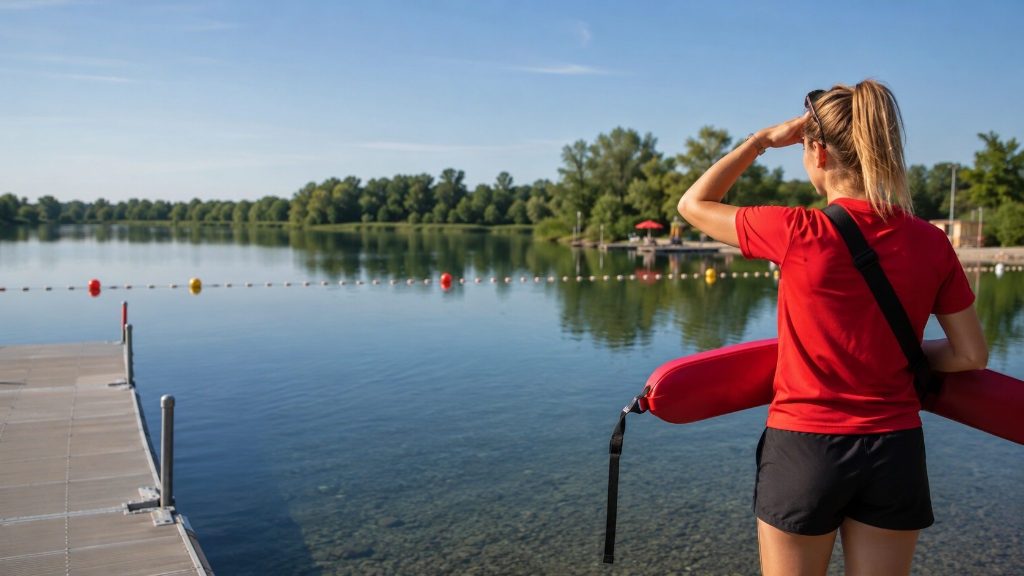
OWL is designed for planned, organised and risk-assessed activity in managed, still, non-tidal open-water environments such as lakes, reservoirs, lidos, outdoor swimming venues and organised events. It is different from NVBLQ, which is focused on beach and surf lifeguarding. Open-water activity should never be treated as guaranteed — it must always depend on conditions, water quality, supervision, risk assessment, emergency arrangements and candidate readiness. If you are unsure which qualification fits your venue or role — contact us and we can help identify the right route.
The specific skills, knowledge and emergency procedures relevant to lifeguarding in managed open-water environments. The summary below explains the key areas candidates and venues should expect — current RLSS UK guidance should always be checked before booking.
Rescue techniques specific to open-water environments — reduced visibility, cold water, variable conditions, unknown depths and the challenges of distance rescue in managed venues.
Assessing open-water venues for specific hazards — water quality, temperature, depth profiles, entry and exit points, sight lines and the specific risks of lake, reservoir and lido environments.
Understanding cold water shock, cold water incapacitation and hypothermia — and how to manage casualties in open-water emergencies where cold is a primary risk factor.
First aid adapted for outdoor and open-water settings — where ambulance access may be limited and the lifeguard may need to manage a casualty for longer before handover to emergency services.
Working within open-water venue operations — swimmer registration and tracking, zone management, lifeguard deployment and emergency procedures for organised swims and events.
Legal and professional requirements for open-water venue lifeguards — duty of care, incident reporting, working within regulated swimming areas, and communication with landowners and event organisers.
Safety-led open-water delivery. OWL training and open-water activity must be shaped by candidate readiness, venue procedures, water temperature, visibility, access and egress, weather, water quality, risk assessment, supervision and emergency arrangements. Course delivery should always follow current RLSS UK standards and venue-specific safety procedures. Open-water activity should never be treated as guaranteed — it must always depend on conditions, water quality, supervision, risk assessment, emergency arrangements and candidate readiness.
OWL is relevant for candidates, venues and organisations working in managed open-water settings where pool or beach qualifications alone may not match the environment. It is suitable for open-water venues, organised swim events, outdoor education settings, adventure centres, holiday parks and activity providers that need lifeguards with specific open-water knowledge and rescue capability.
Tell us about your venue, event or activity setting and we can help you identify whether OWL, NPLQ, NVBLQ or a combination is most appropriate.
Awarding body
RLSS UK — Royal Life Saving Society UK
Minimum age
16 years old at time of assessment
Environment
Managed, still, non-tidal open-water settings: lakes, reservoirs, lidos, outdoor swim venues and organised events
Training commitment
Usually minimum 3 days / at least 18 hours, followed by practical and theory assessment. Check current RLSS UK guidance before booking.
Validity
Normally valid for 2 years from successful completion. Must be renewed in line with current RLSS UK requirements.
OWL entry requirements
Candidates must be able to:
Always verify requirements against the latest RLSS UK guidance before booking.
Sector
Outdoor activities, events, adventure sport, open-water swimming venues. Individual employers may set additional requirements beyond the qualification itself.
Also need pool lifeguard qualification? The NPLQ is the recognised standard for pool environments and pairs well with OWL for multi-environment coverage.
View NPLQ → 🏄Interested in coastal and surf environments as well as open water? The NVBLQ covers beach lifeguarding for tidal and surf environments.
View NVBLQ → 🎓For younger people building towards OWL — the NLA develops open-water confidence, swim fitness, rescue awareness and lifeguard preparation skills.
View NLA →OWL, NPLQ and NVBLQ are separate qualifications for different environments. Some venues or roles may require more than one, depending on the setting, risk assessment and employer requirements.
Contact us to discuss which qualification or combination best fits your venue, role or activity setting.
For venues and event organisers
Yorkshire Lifeguard Academy can discuss OWL training, candidate preparation, staff development and open-water safety workforce planning with venues and organisations that manage open-water swimming, outdoor activity, adventure sport, events, holiday parks, reservoirs, lakes or lidos.
Any course or venue conversation should consider water environment, access and egress, visibility, water temperature, water quality, swimmer tracking, communications, emergency procedures, equipment, safety cover, staffing and current RLSS requirements.
OWL is a lifeguard qualification, not a complete venue safety system. Open-water venues and event organisers still need suitable risk assessments, operating procedures, emergency plans, equipment, communications, water quality arrangements, swimmer management and appropriate safety cover.
OWL enquiries are welcome from candidates, open-water venues, outdoor activity providers, holiday parks and event organisers across the Yorkshire coast, including Whitby, Scarborough, Filey and Bridlington.
Delivered through Bluewatch Training
OWL Open Water Lifeguard sits within the Yorkshire Lifeguard Academy pathway. Formal RLSS course delivery, administration and quality assurance are provided through Bluewatch Training, the professional training arm of Yorkshire Lifeguards.
To enquire about OWL — as a candidate, open-water venue or employer — contact us and we will discuss entry requirements, preparation and course opportunities.
Candidates can contact us about entry requirements, preparation and course opportunities. Venues, event organisers and outdoor activity providers can contact us about staff training, course hosting and open-water safety workforce development.